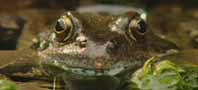
 The common frog can breathe through its skin.
This enables it to hibernate for several months beneath
piles of mud and decaying leaves underwater.
The common frog can breathe through its skin.
This enables it to hibernate for several months beneath
piles of mud and decaying leaves underwater.
The common frog can breathe through its skin.
This enables it to hibernate for several months beneath
piles of mud and decaying leaves underwater.
 Three: R.t.temporaria, R.t.honnorati(colonises an area at the foot of
the Alps)and R.t. parvipalmata (north west Spain and the Pyrenees).
 In the wild, the common frog can live for up to 8 years
 Common frogs have a robust body and relatively short hind limbs with
webbed toes. Males tend to be slightly smaller and darker than
females, and can also be distinguished by the dark bluish-black
nuptial pads (swellings) on their first fingers. These pads become more
pronounced during the breeding season, helping males to grip on to
females during mating. The common frogs' smooth skin varies in
colour from grey, olive green and yellow to various shades of brown
and is covered with irregular dark blotches. Common frogs have a dark
'mask' enclosing their eyes and eardrums, and often have barred markings
on their limbs and flanks. Their undersides are white or yellow,
sometimes orange in females, and are often covered with brown or
orange speckles. Completely red or black individuals are
occasionally found in Scotland, and some individuals may turn blue
during the breeding season. Albino common frogs have been found
with yellow skin and red eyes. Common frogs also have the ability
to lighten or darken their skin to match their environment. Common
frogs have brown eyes with black horizontal pupils, and transparent
inner eyelids that protect their eyes while they are underwater.
Common frogs have a robust body and relatively short hind limbs with
webbed toes. Males tend to be slightly smaller and darker than
females, and can also be distinguished by the dark bluish-black
nuptial pads (swellings) on their first fingers. These pads become more
pronounced during the breeding season, helping males to grip on to
females during mating. The common frogs' smooth skin varies in
colour from grey, olive green and yellow to various shades of brown
and is covered with irregular dark blotches. Common frogs have a dark
'mask' enclosing their eyes and eardrums, and often have barred markings
on their limbs and flanks. Their undersides are white or yellow,
sometimes orange in females, and are often covered with brown or
orange speckles. Completely red or black individuals are
occasionally found in Scotland, and some individuals may turn blue
during the breeding season. Albino common frogs have been found
with yellow skin and red eyes. Common frogs also have the ability
to lighten or darken their skin to match their environment. Common
frogs have brown eyes with black horizontal pupils, and transparent
inner eyelids that protect their eyes while they are underwater.
This species is one of the most widespread and common species of brown frog (member of the Ranidae family) in Europe. They are widespread and native to mainland Britain and have been introduced to Ireland, where their distribution is patchy. They have also been introduced to the Isle of Lewis, Shetland and Orkney Islands. Common frogs are also found in Asia, and eastward to Japan.
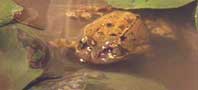 Common frogs are largely terrestrial outside the breeding season,
and can be found in meadows, gardens and woodland. They breed in puddles
, ponds, lakes and canals, preferring areas of shallow water.
Common frogs are largely terrestrial outside the breeding season,
and can be found in meadows, gardens and woodland. They breed in puddles
, ponds, lakes and canals, preferring areas of shallow water.
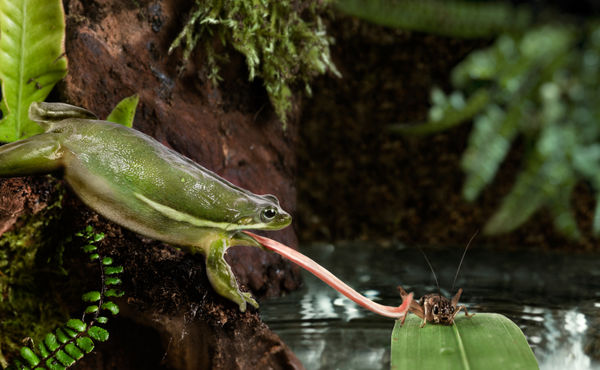 Common frogs do not feed at all throughout the breeding season,
but when they are active they will feed on any moving invertebrates
of a suitable size, such as insects, snails, slugs and worms,
which they catch with their long, sticky tongues.
Adult frogs feed entirely on land, whereas younger frogs will also
feed in the water. Tadpoles are herbivorous and feed on algae
but become carnivores when they mature into adult frogs.
Common frogs do not feed at all throughout the breeding season,
but when they are active they will feed on any moving invertebrates
of a suitable size, such as insects, snails, slugs and worms,
which they catch with their long, sticky tongues.
Adult frogs feed entirely on land, whereas younger frogs will also
feed in the water. Tadpoles are herbivorous and feed on algae
but become carnivores when they mature into adult frogs.
 Although common frogs are active both day and night,
they tend to be more active at night.
During the winter they hibernate in compost heaps,
under stones and logs, or underwater beneath piles of mud and
decaying leaves.
Although common frogs are active both day and night,
they tend to be more active at night.
During the winter they hibernate in compost heaps,
under stones and logs, or underwater beneath piles of mud and
decaying leaves.
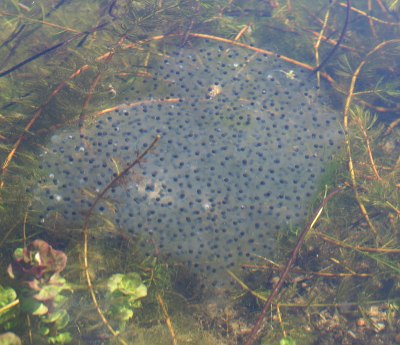 Common frogs become sexually mature at around three years of age.
During February and March they begin to emerge from hibernation
and make their way to the breeding grounds.
Common frogs have been seen to return annually to the sites where
they originally developed from spawn into adult frogs.
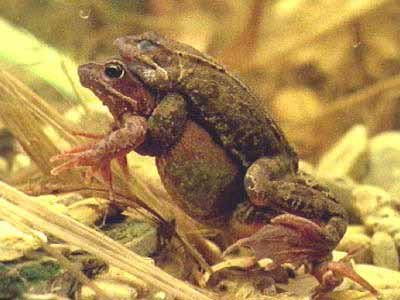
The males arrive first and attempt to attract a mate by producing
a low purring croak. A successful male will wrap his forelimbs
around the female in a mating embrace known as 'amplexus'.
Each female lays 1000-4000 eggs at a time, which are fertilised
by the male as they are released. Frogs can spawn as early as
December and as late as April, depending on how warm the weather is.
They prefer to lay their eggs in shallow, still water.
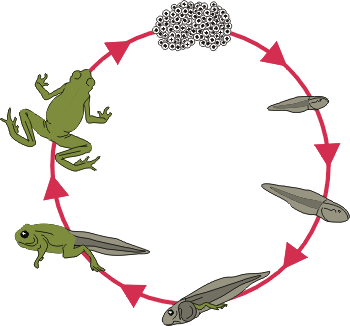
Frogspawn is surrounded with a clear jelly-like substance,
which swells up in the water to protect the fragile embryos.
The spawn floats to the surface in large round clumps
so that the sun can warm the eggs. After 30 to 40 days,
tadpoles begin to emerge from the jelly-like spawn.
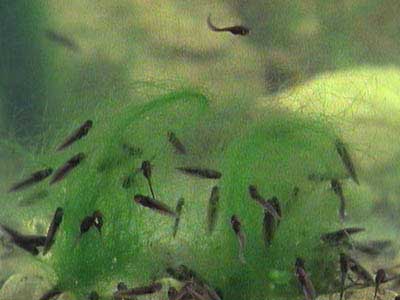
The tadpoles feed on the spawn for the first few days until
they begin to eat algae. Tadpoles change into frogs through a
process called ‘metamorphosis’, which takes between 12 and 14 weeks.
Both spawn and tadpoles are extremely vulnerable,
and many get eaten by predators such as fish, birds and grass snakes.
On average, only 5 out of every 2000 eggs will survive to become
adult frogs. When tadpoles hatch they have gills that allow them to
breathe underwater. After 9 weeks they have lost their gills
and developed lungs, and therefore must swim to the surface to
breathe. As they grow, tadpoles begin to feed on insects as well
as plants. Hind legs develop between 6 and 9 weeks,
and front legs are fully developed after about 11 weeks.
The tail begins to be absorbed by the developing tadpole,
and by 12 weeks it has practically disappeared, leaving a tiny
froglet. At this stage the tadpoles are less dependent on water
and will hide in long grass in and around the pond.
Common frogs become sexually mature at around three years of age.
During February and March they begin to emerge from hibernation
and make their way to the breeding grounds.
Common frogs have been seen to return annually to the sites where
they originally developed from spawn into adult frogs.
The males arrive first and attempt to attract a mate by producing
a low purring croak. A successful male will wrap his forelimbs
around the female in a mating embrace known as 'amplexus'.
Each female lays 1000-4000 eggs at a time, which are fertilised
by the male as they are released. Frogs can spawn as early as
December and as late as April, depending on how warm the weather is.
They prefer to lay their eggs in shallow, still water.
Frogspawn is surrounded with a clear jelly-like substance,
which swells up in the water to protect the fragile embryos.
The spawn floats to the surface in large round clumps
so that the sun can warm the eggs. After 30 to 40 days,
tadpoles begin to emerge from the jelly-like spawn.
The tadpoles feed on the spawn for the first few days until
they begin to eat algae. Tadpoles change into frogs through a
process called ‘metamorphosis’, which takes between 12 and 14 weeks.
Both spawn and tadpoles are extremely vulnerable,
and many get eaten by predators such as fish, birds and grass snakes.
On average, only 5 out of every 2000 eggs will survive to become
adult frogs. When tadpoles hatch they have gills that allow them to
breathe underwater. After 9 weeks they have lost their gills
and developed lungs, and therefore must swim to the surface to
breathe. As they grow, tadpoles begin to feed on insects as well
as plants. Hind legs develop between 6 and 9 weeks,
and front legs are fully developed after about 11 weeks.
The tail begins to be absorbed by the developing tadpole,
and by 12 weeks it has practically disappeared, leaving a tiny
froglet. At this stage the tadpoles are less dependent on water
and will hide in long grass in and around the pond.
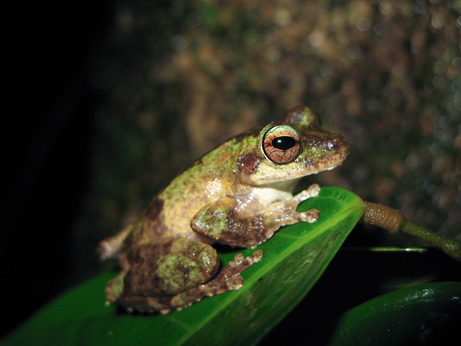 The common frog is protected under the Wildlife and Countryside
act 1981. This species is not listed by the IUCN. Populations can
be threatened in areas where breeding ponds are disturbed or polluted.
The common frog is protected under the Wildlife and Countryside
act 1981. This species is not listed by the IUCN. Populations can
be threatened in areas where breeding ponds are disturbed or polluted.
Males emit a low purring croak during the breeding season, but this can only be heard up to 50 metres away because common frogs do not have any vocal sacs.
Common frogs can breathe through their skin as well as their lungs. Their eyes and nostrils are on top of their heads so they can see and breathe even when most of their body is underwater.